Systems glossary and checks

Terms the guides actually use, plus self-checks. The mistakes list and quiz cover rope-solo, hauling, anchors, rappelling, and top-rope solo. A high score is not training.

Back to the guide library.

Systems glossary

Terms used in the systems guides. Search or filter by letter.

Equipment & Gear

Aiders / Etriers
Webbing ladders clipped to a placement so an aid climber can stand and reach the next piece.
Chest harness
Keeps a lead-solo device upright on the torso so the cam stays oriented as you climb.
Daisy chain
Adjustable tether from harness to a piece. Used to sit or clip close; never the only belay.
Dynamic rope
Stretchy lead rope that absorbs a fall. Required for lead solo; static line is for fixing and hauling.
GriGri
Petzl assisted-braking belay device. Designed for belaying and lowering a partner. Petzl does not authorize self-belay or modifying it for lead solo.
Haul bag
Stiff pig used to haul food, water, and bivy gear. On a wall the haul is often harder than the climbing.
Jesus piece
First protection off the solo belay, placed immediately to keep a fall from hitting the anchor at factor 2.
Micro Traxion
Petzl progress-capture pulley. Used in hauling and some solo backups. Not a complete lead-solo system by itself.
Portaledge
Hanging cot and fly for sleeping on blank walls. Practice deploying it on the ground.
Progress capture
Pulley, device, or knot that lets rope run one way and locks the other. Core of hauling and many solo backups.
Rope bag / rope bucket
How a soloist feeds a flake without a partner stacking. Tangled flake equals a hard lock or a surprise dump of slack.
Silent Partner
Mechanical lead-solo device (now out of production) that paid slack and locked in a fall. Historical comparison, not a current buy.
Static rope
Low-stretch line for fixing, hauling, and rapping. Do not lead-solo on it.
Tag line
Thin second cord used to haul, pull a rap line, or back up a cut main rope.

Techniques & Methods

Clean aid
Aid that uses removable gear only — no hammered pitons — so the rock is not damaged.
Docking
Tying the haul bag to the anchor so it is no longer hanging only on the pulley before you reset the haul.
Fixed rope
A rope left in place for jumaring or top-rope solo. Different problem than leading with the rope below you.
Haul system
Progress-capture pulley plus a 1:1 or 3:1 so the leader or second can move the pigs. Needs a redirect that will not shred the rope.
HUUD
Held upright and upside-down: community GriGri lead-solo orientation. Climber side takes the load from the anchor. Petzl does not authorize this use.
Jumar / jumaring
Ascending a fixed rope with mechanical rope grabs. How most big-wall seconds follow.
Lead rope solo
Leading upward while a device or knot system feeds and then locks, with no belayer. You manage slack, clips, and backups yourself.
Lower-out
Controlled pay-out from a directional — a traverse piece or a hanging pig — so you (or the bag) go plumb instead of penduluming.
Nailing
Hammering pitons or copperheads when clean gear will not hold. Last resort on modern walls, still required on some aid.
Top-rope solo
Self-belay on a rope already anchored above you. Shorter falls than lead solo; still needs two independent grabs or a backup.
V-thread
Abalakov: two intersecting ice-screw holes threaded with cord for a rappel or belay anchor in thick ice. Inspect the ice, not just the knot.
Z-drag
3:1 haul that turns a stuck pig into a slower stuck pig if the capture pulley is oriented wrong.

Safety & Protection

Backup knot
Figure-8 or overhand on a bight on the brake strand every 5 m (about 3 m for the first pieces and any crux). Clip each knot to its own gear loop. Never skip the first knot below the device.
Factor 2 fall
Fall distance twice the rope out, usually onto the belay. Worst-case start of a lead-solo pitch before the first piece.
Multi-directional anchor
A solo start anchor that can take an upward yank when the first piece loads, not only a downward pull.
SERENE / ERNEST
Anchor checks: Solid, Equalized, Redundant, Efficient, No Extension — or Equalized, Redundant, No Extension, Solid, Timely.

Common setup mistakes

Checks against the lead-rope-solo guide — not instruction. Petzl does not authorize a GriGri for self-belay. A passing read here is not a reason to leave the ground.

Critical Risk
High Risk
Medium Risk

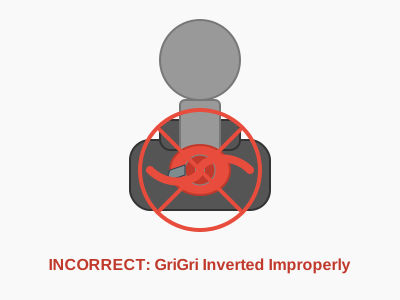
Incorrect GriGri OrientationCritical Risk

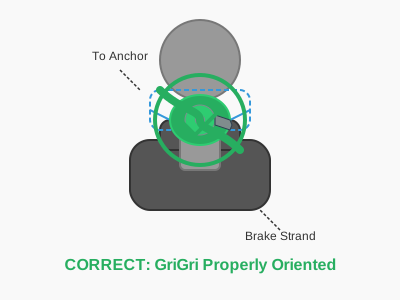
The usual lead-solo orientation is upside-down compared with belaying a partner (HUUD): rope from the anchor enters the climber side. The fatal mistake is using partner-belay orientation on your chest, or feeding the wrong strand into the cam. Upside-down is not the error. Wrong rope path is.

INCORRECT SETUP

Incorrect Incorrect GriGri Orientation

Potential Consequences:

Wrong rope path means the cam never sees a fall. You hit the ground.

CORRECT SETUP

Correct Incorrect GriGri Orientation

Proper Solution:

Petzl does not authorize GRIGRI, GRIGRI +, or NEOX for self-belay. If you still study the community rig: climber-side takes the load strand from the anchor, brake strand exits to the free end, chest tether holds the device so the cam can close. Weight-test on the ground before you leave it.

Knowledge Check: Rope Soloing

Self-check on Rope Soloing (intermediate level). Passing does not mean you are ready to solo.

Questions: 5. Modules: rope-solo, hauling, anchors, rappelling, top-rope solo.

Petzl does not authorize GRIGRI, GRIGRI +, or NEOX for self-belay. See the technical notice.

Questions the guides already answer

Does Petzl authorize a GriGri for self-belay?

No. Petzl does not authorize GRIGRI, GRIGRI +, or NEOX for self-belay, and does not authorize modifying the device for lead solo. The GriGri pages on this site are an educational systems reference, not permission to solo.

What is the difference between lead rope solo and top-rope solo?

In lead rope solo the rope is below you and you place protection as you climb. In top-rope solo the rope is already fixed above you and you track it with progress-capture. They are different systems with different failure modes.

What is the backup-knot rule for lead rope solo?

Tie a figure-8 or overhand on a bight on the brake strand every 5 m (about 3 m for the first pieces and any crux). Clip each knot to its own gear loop. Untie as you pass it. Never skip the first knot below the device.

What is a Jesus piece?

The first protection off a solo belay, placed within 1–2 m so a fall does not hit the start anchor at factor 2.

When is a sliding-X the wrong tool?

On a solo start a sliding-X equalizes until one piece fails, then it extends. That extension is a bigger fall onto the remaining piece. Use a pre-equalized cordelette or a quad if you cannot accept extension.